
Phew Blog
If your B2B team is deciding where to invest on LinkedIn, the short answer is simple: personal profiles now do more of the trust-building and interpretation work, while company pages play a support role.
That does not mean company pages are useless. It means the jobs are different now.
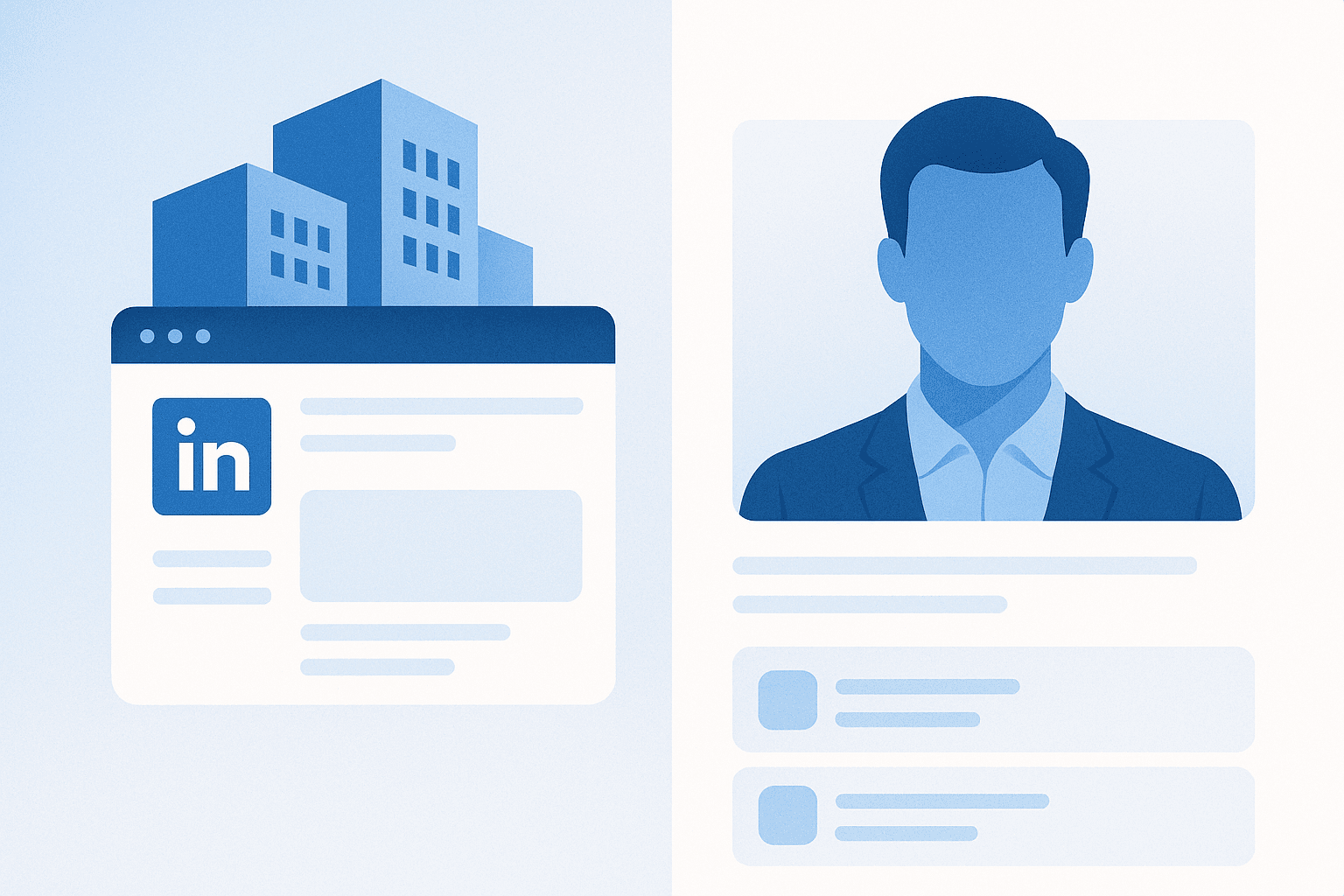
The company page is the archive. The expert voice is the engine.
A lot of teams still treat those as interchangeable channels. They are not. One is better at publishing official information. The other is better at publishing judgment the market will actually remember.
Most LinkedIn advice flattens the problem into a simple rule like, "people trust people" or "brands should post more consistently." Both are directionally true, but they miss the operational reality.
Company-page content usually goes through more approvals, gets softened to satisfy more stakeholders, and loses the exact specificity that would have made it worth reading. The result is often correct but forgettable.
Personal-profile content works differently. A founder, operator, or subject-matter expert can react faster, use sharper language, and connect the point to real tradeoffs, decisions, and customer patterns. That is what readers trust.
The common mistake is asking the company page to do interpretation when it is structurally better at documentation.
A clean way to think about the split is this two-part model.
Use the company page for content that should feel official, referenceable, and easy to find later.
Use personal profiles for content that needs conviction, speed, and interpretation.
If the post needs authority through lived judgment, it usually belongs on a person first. If it needs official clarity or durable reference value, it belongs on the company page.
Imagine your team ships a feature that helps consultants turn raw notes into ready-to-post LinkedIn drafts faster.
The company page should publish the factual layer: what launched, who it is for, what changed, and where to learn more.
A founder or operator should publish the interpretation layer: why customers were getting stuck before, what behavior the product is trying to change, what this reveals about the market, and where most teams still get the workflow wrong.
Those are not duplicate posts. They are complementary assets.
The company page records the event. The personal post explains why the event matters.
LinkedIn did not kill company pages. It quietly narrowed their role.
Over time, the platform kept rewarding named expertise, authored perspective, and people-powered distribution more than generic brand narration. That does not mean every individual post outperforms every company-page post. It means the platform increasingly favors content that feels attributable to a real person with a clear point of view.
That shift matters because it changes where trust gets created first. In many B2B categories, the brand now consolidates trust more often than it originates it.
That is a strategic difference, not a cosmetic one.
Copying the same message onto the company page and an executive profile usually weakens both. Each surface should do a different job.
The sharper the opinion, the more it usually benefits from a real author. Let the human create interpretation, then let the brand reinforce it.
For many B2B teams, the better question is whether expert-led posts are creating qualified conversations, profile views, demo curiosity, and category association.
Open your next five planned LinkedIn posts and sort each one into one of two buckets.
If more than half of your strongest ideas are sitting in the archive bucket, your mix is probably backwards.
A better system is usually:
That takes about five minutes to diagnose and usually reveals why the current system feels flatter than it should.
Phew is most useful when the bottleneck is not typing, but deciding what is worth saying, shaping it in a specific voice, and getting from signal to publishable output before the moment passes. If that sounds familiar, related reading includes repeatable content systems for busy experts, Phew vs Taplio, and Phew vs Typefully.
If you do want to try Phew free for 7 days and see your social score, here is where to start.